You need to make a more elaborate mold with pin guides that ensure the the mold plug punch is centralised in the upper half of mold with the hole during the molding process.
I used 2 pin guides but ideally make 4 pin guides as it will help during the molding process, with 2 pins the mold rocked corner to corner a bit and I had to manually steady the mold during the pressing process.
I used a 76mm hole saw to cut a hole on one piece of 18mm ply which was 180mm square and I drilled 6mm holes for my guides. For my guides I used some partially threaded dome bolts.
In short, find 4 suitable partial headed bolts, it doesn't matter what size but make sure the partial headed part is at least 36+mm long for the 2 x 18mm ply halves you use and cut the bolt down just above the thread so the blank part of bolt is acting as the smooth guide of the bolt for the mold press. Whatever size bolt you use just ensure you use a +.5mm sized drill bit so the two halves of the mold still press down centrally without snagging during the molding process.
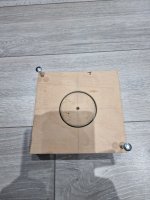
Now cut your perforated PVC plastic mesh so it fits just shy of the 2/4 pin guides and staple the PVC mesh on or 4 corners to the top 18mm ply with the 76mm hole cut into it. We want to restrict any movement from all 4 sides so the only area which can move is the area heated during the molding process otherwise the surrounding mesh material will naturally want to be drawn down into the hole and will end up wrinkling rather than being a tight localised stretched of the PVC mesh.
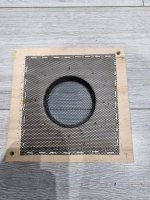
Also, the reason for the 180mm square ply is we don't want to see any staple marks in the finished product do we?, so we can cut away the excess damaged area leaving the original sized speaker grill still intact. The below picture is after the pressing and as you can see we can extract the grill and by using the original grill as a template we can cut away any excess 'staple damaged' material.
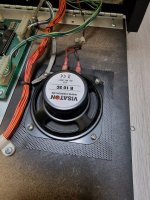
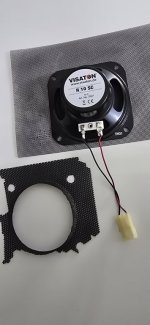
There are 4 enlarged holes in the original Williams speaker grills and I am guessing these holes were not only used for the speaker screws access but also used in manufacturing to limit the surrounding areas of the mesh from being drawn into the hole during the mold process at factory.
Molding process:-
With the flat mesh stapled across the hole on all 4 sides gently heat the mesh with a hair dryer using its highest heat setting and aim the heated air through the hole above the punch press round piece of wood on the bottom half. Pressing on the top half of the mold whilst heating you will feel the top half of the mold with the hole and mesh will start to sink down over the bottom plug of circular wood and the PVC mesh will start to expand.
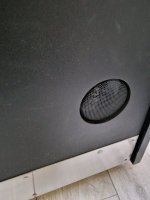
Once the 2 halves have met you have a fully formed Williams cocktail speaker mesh!
Tip: Ensure you use 4 pin guides will ensure the mesh expands centrally