Galaxian bootleg shorting

Judder

Active member
Feedback
2 (100%)
Credits
992CR
Hi and a long time absent so hope everyone is well!

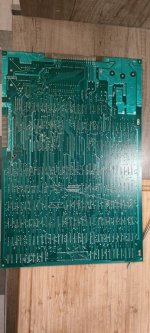
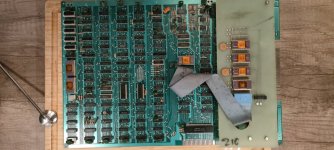
I've been tidying up my remaining boards and on the way found this Galaxian bootleg which I thought would be an interesting project to get running

The problem is that with power applied, the power supply immediately shuts down as there is a short between +5V and GND, specifically GND and the 3rd +5V pin which I believe is E (top board) and 5 (bottom board)

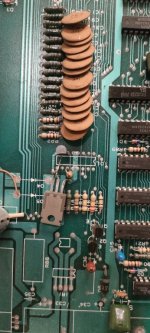
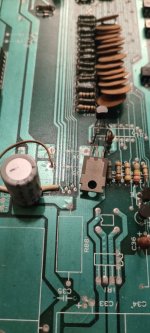
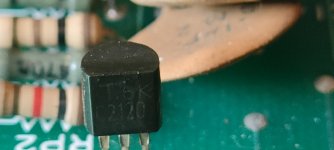
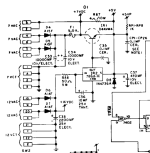
This part of the board appears to be connected on original boards to a ULN 2075B Quad NPN Darlington Transistor and for this board it looks like the builders have swapped this out with two NPN transistors, namely a 2SC1061 NPN bigger transistor and a C2120 NPN smaller transistor wired up in what looks like a Darlington pair format

So, here's the question for the Galaxian experts out there, can I simply disconnect the +5V being fed to this part of the circuit to avoid the short and just use pins 3 & 4 and C & D to supply +5V power to the board to avoid the short?

There doesn't appear to be a short between GND (1 & 2 and A & B) and +5V (3 & 4 and C & D) and what is the purpose of the Darlington array part of the circuitry - my guess is that it is either to do with sound amplification or A/C conversion but would love to know what it really does

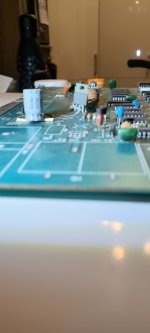
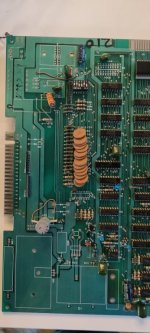
Here's some photos of the board and that part of the circuit

Many thanks for any tips and pointers! Alex

Top of the board
GalaxianBoardTop.jpg

Bottom of the board

GalaxianBoardBottom.jpg
NPN Darlington Pair

NPNDarlingtonPair.jpg

NPNDarlingtonPair2.jpg

SC1061

SC1061.jpg

C2120

C2120.jpg
 

philmurr

Active member
vacBacker
Feedback
46 (100%)
Credits
2,310CR
Hi Alex - nice to see you back on here :)

You can remove the transistors, everything around 10L is for the coin counter and other high current outputs (coin lockout, flashing P1/P2 start)

Pin 5 on the edge connector is also for the coin counter so you can also ignore that as the board looks to have never been AC-powered and just takes DC

Can you also check to see where the wire from the diode position next to the edge connector is going?
 

Judder

Active member
Feedback
2 (100%)
Credits
992CR
Thanks Phil and Georgian2 - nice to be back and always fun with an odd bootleg to try and fix too :)

The wire bridging the diode original location near the edge connector is connected to the positive side of the 25V 270uF capacitor that is bridging GND (on the bottom) and the +V rail that leads up to the 210 written on the board

25V470uFCapacitor.jpg

AerialView10LSection.jpg

I actually desoldered the SC1061 transistor from the board last night to try and break the short, but weirdly it is still happening even though I can't see where, apart from the circuitry around 10L that that E / 5 edge connector is connected

My Galaxian -> JAMMA adapter has +5V connected to E / 5 so my next strategy is to desolder that wire and see if I can get a non-short from the board, unless there is an easier way :)
 

Judder

Active member
Feedback
2 (100%)
Credits
992CR
FYI this is how this section looks on an original board (converted to D/C), which is what I was comparing it with

You can see on the bootleg they didn't bother with any of the pads for D9 or D10, and on the bottom of the board around 10L there is a PCB link from pin 8 of the ULN2074B and pin 1 of the ULN2074B

Screenshot 2025-12-02 at 12.21.27.png
 

Hexen

Active member
Feedback
2 (100%)
Credits
487CR
Thanks Phil and Georgian2 - nice to be back and always fun with an odd bootleg to try and fix too :)

The wire bridging the diode original location near the edge connector is connected to the positive side of the 25V 270uF capacitor that is bridging GND (on the bottom) and the +V rail that leads up to the 210 written on the board

View attachment 49050

View attachment 49051

I actually desoldered the SC1061 transistor from the board last night to try and break the short, but weirdly it is still happening even though I can't see where, apart from the circuitry around 10L that that E / 5 edge connector is connected

My Galaxian -> JAMMA adapter has +5V connected to E / 5 so my next strategy is to desolder that wire and see if I can get a non-short from the board, unless there is an easier way :)
Try one of those Tantalums. They just love going short.
 

Judder

Active member
Feedback
2 (100%)
Credits
992CR
Try one of those Tantalums. They just love going short.
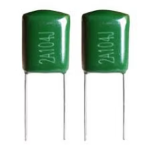
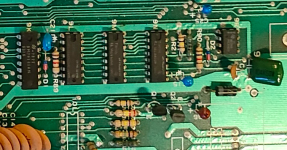
The green capacitors all over the place that look like this?

GreenCapacitor.png
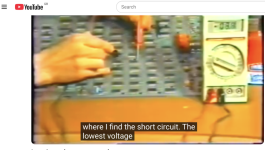
On my research journey I found this good post by guddler tracking down his short which then led me to this post on arcade-museum which has a link to this excellent YouTube video of some old VHS tape from somewhere showing how you can use a battery connected to your board to track down where the short is - a clever trick and fascinating to watch!

Screenshot 2025-12-02 at 15.27.44.png
 

Georgian2

Active member
Feedback
12 (100%)
Credits
1,766CR
Are you sure you are using the right adapter? It's been a while since I fixed one of these. I can't rember but I thi nk the pinout is a little different then original. If you meassure the restince between VCC and GND on some IC, what do you get?
 

Judder

Active member
Feedback
2 (100%)
Credits
992CR
Are you sure you are using the right adapter? It's been a while since I fixed one of these. I can't rember but I thi nk the pinout is a little different then original. If you meassure the restince between VCC and GND on some IC, what do you get?
That's a very valid point and I hadn't actually thought that that would be the case

Looking at this bootleg PCB on Aussie Arcade it seems to be the same layout as the one I have - with the two NPN transistors and no amplifier on the PCB

https://wiki.aussiearcade.com/index.php?title=PCB_Repair_Logs_Galaxian_Bootleg

I can't find a definitive pin-out for it but yes it is entirely possible that the pin-out requires output E / 5 not being connected as my Galaxian adapter has to +5V
 

Judder

Active member
Feedback
2 (100%)
Credits
992CR
If you measure the restance between VCC and GND on some IC, what do you get?

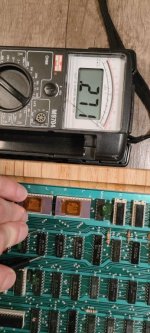
Measuring between +5V and GND on the 74SL194s near the top gives me 13.4 Ohm resistance, the same if I measure between any of the test points on the +5V and GND rails around the board

If I put the multimeter in continuity / diode mode, across any of the 104K 50V green capacitors I am getting .262 (which appears very close to 0 / short-circuit) and the same between the +5V and GND rails around the board

The only part of the board where the 104K 50V green capacitors gave an infinite reading was on the sound board section, which I guess must be isolated from the rest

IMG20251202180248.jpg

IMG20251202180800.jpg

IMG20251202181122.jpg

IMG20251202181647.jpg
 

Hexen

Active member
Feedback
2 (100%)
Credits
487CR
The green capacitors all over the place that look like this?

View attachment 49056
On my research journey I found this good post by guddler tracking down his short which then led me to this post on arcade-museum which has a link to this excellent YouTube video of some old VHS tape from somewhere showing how you can use a battery connected to your board to track down where the short is - a clever trick and fascinating to watch!

View attachment 49057
No, the little bead/teardrop shaped ones in red and blue. They should have a '+' printed somewhere as they're polarised unlike the green ones you've shown which are just for decoupling and rarely short out.

Such as C15 or C36. You may have to desolder a leg, or just replace them with standard electrolytics. Check them all.

And I'd not recommend using batteries on boards to trace shorts. You could even use a small drill bit with your fingers, not a drill) to cut tracks and isolate parts of the board to find the short.
 
Last edited:

Judder

Active member
Feedback
2 (100%)
Credits
992CR
No, the little bead/teardrop shaped ones in red and blue. They should have a '+' printed somewhere as they're polarised unlike the green ones you've shown which are just for decoupling and rarely short out.

Such as C15 or C36. You may have to desolder a leg, or just replace them with standard electrolytics. Check them all.

Thanks - got it - and yes I will try that tonight (y)
 

Judder

Active member
Feedback
2 (100%)
Credits
992CR
Just looking at the schematics and the Tantalum capacitors are marked as

C36 - 10MF 35V Tant - Red
C15 (Audio Timer), C25 (Fire) - 1MF 35V (16V on item list) Tant - Blue
C21 (Hit) - 2.2MF 25V (16V on item list) Tant - Blue

C49 (Amp) - 0.47MF 25V Tant - Missing

Are these old values for mF and is 1MF equal to 1000nF / 1uF for normal electrolytic capacitors?

These are the 4 as far as I can tell that are on my board

Screenshot 2025-12-03 at 11.18.06.png
 
Last edited:

Hexen

Active member
Feedback
2 (100%)
Credits
487CR
Just looking at the schematics and the Tantalum capacitors are marked as

C36 - 10MF 35V Tant - Red
C15 (Audio Timer), C25 (Fire) - 1MF 35V (16V on item list) Tant - Blue
C21 (Hit) - 2.2MF 25V (16V on item list) Tant - Blue

C49 (Amp) - 0.47MF 25V Tant - Missing

Are these old values for mF and is 1MF equal to 1000nF / 1uF for normal electrolytic capacitors?

These are the 4 as far as I can tell that are on my board

View attachment 49098
OK, so C15 or 25 won't be candidates (test anyway), just any of them across that shorted power line. Just do a continuity test on one, if it appears short, test it out of circuit.

It's almost impossible that it would be one of the standard fat green things, are they 100nf or similar? Send a link to the schematic you are using if you can.

I've had shorted tantalums on RML computers, gameboards, many, many power supplies... love the cute little things, but they can be problematic.

Another thing to look at would be any excessively hot ICs or components if it's not a tantalum.

Yes, the values are standard, 1mfd - 1 microfarad, 1000nf, 1uF.
 
Last edited:

Hexen

Active member
Feedback
2 (100%)
Credits
487CR
I'm looking at C36, there are two pictures, although a bit fuzzy... is that a black mark on the top? It's connected directly to what looks like GND... check that one first.
 
Last edited:

Judder

Active member
Feedback
2 (100%)
Credits
992CR
OK, so C15 or 25 won't be candidates (test anyway), just any of them across that shorted power line. Just do a continuity test on one, if it appears short, test it out of circuit.

It's almost impossible that it would be one of the standard fat green things, are they 100nf or similar? Send a link to the schematic you are using if you can.

Thanks and yes I'm using the original schematic from the Midway Parts & Operating Manual over at KLOV

C21 and C25 are over in the sound generation part of the schematic

Screenshot 2025-12-03 at 14.30.13.png|

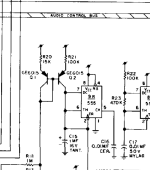
and C15 is part of the audio circuit too so it looks like they would be unlikely candidates to be taking the whole board down (*but will check anyway)

Screenshot 2025-12-03 at 14.30.36.png

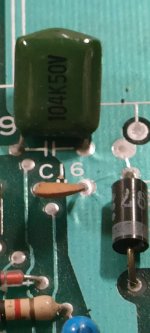
The fat green decoupling capacitors are 104K 50V and I metered across all of those in continuity mode and none were giving a short as far as I could tell

IMG20251202181122.jpg

C36 however I have just found on the schematic and that is used as part of the AC power conversion circuit, so that could be very well be our candidate

Screenshot 2025-12-03 at 14.41.02.png

I will report back...
 

Hexen

Active member
Feedback
2 (100%)
Credits
487CR
OK, if you do a continuity test between the power pins on any of the TTL devices, what do you get? Pins 7/14 on 14 pin devices, 8/16 on 16 pin devices?

Will grab the midway schema and have a look.
 

Judder

Active member
Feedback
2 (100%)
Credits
992CR
Capacitor day:

I grabbed a couple of the handy Peak meters I have and went checking all of the capacitors in-circuit to see if any of them were obviously reporting faulty

1. C36 - 10MF 35V Tant - Red

First up, C36, the one that we thought might be causing trouble as it is a. a Tantalum capacitor and b. it is bridging +5V and GND

Expected: 10uF
Actual: 11.17uF (ESR 0.53 Ohms)

This one is actually pretty spot on


C36Test.jpg


2. C15 (Audio Timer) - 1MF 35V (16V on item list) Tant -
Blue

Next up the two 1uF blue tant capacitors

Expected: 1uF
Actual: 0.98uF (ESR 5.4 Ohms)

Again, pretty spot on even if the ESR is a bit high

C15Test.jpg


3. C25 (FIRE) - 1MF 35V (16V on item list) Tant -

Blue

Expected: 1uF
Actual: 1.02uF (ESR 7.0 Ohms)


C25Test.jpg

4. C21 (HIT) - 2.2MF 25V (16V on item list) Tant -
Blue

Expected: 2.2uF
Actual: 0.9uF (ESR 7.0 Ohms)
The initial test came through a bit low, so I ran it again with the passive component analyser (do love these little meters) and it came out fine

Expected: 2.2uF
Actual: 2.17uF


C21SecondTest.jpg

So those all look fine, and for good measure I did all of the Electrolytic Capacitors dotted around the board

5. C40 (over by the power circuit but I can't find it on the schematic)

Expected: 470MF 10V = 470uF
Actual: 54.97uF (ESR 0.56 Ohms)


6. C31 (part of the Z80 reset circuit)
Expected: 10MF 10V = 10uF
Actual: 13.51uF (ESR 1.8 Ohms)


7. C28 (part of the FIRE sound circuit)
Expected: 47MF 10V = 47uF
Actual: 55.58uF (ESR 0.38 Ohms)


8. C24 (part of the HIT sound circuit)
Expected: 10MF 10V = 10uF
Actual: 12.9uF (ESR 1.26 Ohms)

Next steps:

I'm tracing our the circuit from pin 5 / E of the edge connector across the board to see where it is still connected as we have already removed the initial SC1061 NPN transistor and that tested fine, so I'm going to try desoldering the SC2120 NPN transistor and see if that is causing our short. I will report back...

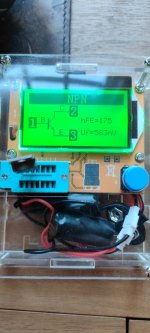
SC1061 tested in handy component tester, now powered by reclaimed rechargeable disposable vape battery :)

HandyComponentTester.jpg
 
Top