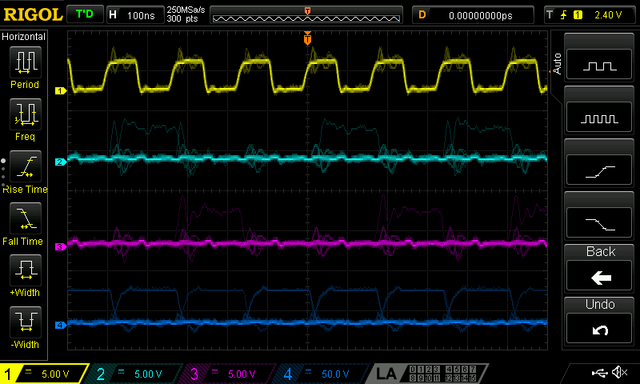
LS74 Flipflow Trace

biglouie

Active member
vacBacker
Credits
84CR
This is an LS74 flipflop. Pins 2, 3 and 5.

1 - Data - Yellow - Pin 2

2 - CLK - Blue - Pin 3

3 - Output - Purple - Pin 5

Output is written when clock goes up, so reflects data at that point. Until clock goes up again and then it writes what ever the data is showing.

This looks sort of ok, but I was wondering WHEN the chip decides what "rising edge" is and when it starts, as this doesn't look very sharp. Output looks slightly delayed..

DS1Z_QuickPrint19.png


biglouie2021-04-22 21:56:38
 

John Bennett

Senior Member
vacBacker
Feedback
10 (100%)
Credits
5,332CR
I'd say it looks ok - especially if you take Ken's values.

Where's the scope ground connected and is this the max acquire rate for the scope? Just looks a little softer than I'd expect for 6MHz (but still OK).

Which part of what game is this from?
 

biglouie

Active member
vacBacker
Credits
84CR
Still GnG John! I know, I know..

I have sorted a few other boards that were way easier to get running!!

Its a DS1074z plus as you recommended actually. I haven't shelled out for the MSO cable. £250 quid for a cable seems a bit sporty, I'll save that for when I need a divorce..

This is the first flipflop (74) after the crystal. 3K iirc


Just working my way out from the clock again really, to get the hang of multiple signals, 74 was easiest to understand what to expect to see.


Regarding grounding, probably not the best.


Apologies to everyone that will find this is an utter abomination! Just learning here! :)

I have these three probes on short cables, all connecting to one 30cm long cable, connected to the GND on the jamma harness. Do all probes need to be grounded? Or just one? Ideally, I'd find a spot on the board thats closer, but there aren't any good places to hook into on GnG.

Replacing some caps on another board, I started to leave the legs longer, just so I have test points to get onto!!!

biglouie2021-04-22 21:58:44
 

biglouie

Active member
vacBacker
Credits
84CR
More flip flop action, but related to LS161 counting...

I have 3 probes on 3L, to check the flip flop in the middle of the 161s.


Probe 1 - Yellow - Pin 3 - CLK

Probe 2 - Teal - Pin 2 - Data

Probe 3 - Purple - Pin 5 - Output

Probe 4 - Blue - Pin 15 on 1K


The ghosting confuses me. I cant seem to get a decent strong trace but do see some faint lines.

I was wondering why that might be and what I am doing wrong on the set up. Maybe I need to take off auto and trigger manually..

Pin 9 on all 161s is high.. Schematic says active LO. So something to investigate there..

All confusing.

biglouie2021-04-23 10:19:41
 

John Bennett

Senior Member
vacBacker
Feedback
10 (100%)
Credits
5,332CR
The ground really needs to be a 0V on the chip you're testing if you want a really strong trace, otherwise that long ground cable is acting a bit like an aerial.

Pin 9 makes the counters restart, and they'll restart at the value on the ABCD pins, rather than zero - it's easier this way - if your counter goes to 16 but you only want 11 counts, then start the counter at 5 instead of putting in logic to look at the count and clear it.

Trigger the scope on the signal you're interested in. Pin 9 is linked to the carry-out (pin 15). So when the counter reaches maximum (16) it'll pulse the carry out, which is then fed back into the load pins to make the counters restart.

So if you look at 2K and 1K, they are two counters chained up to count from 64 (binary 0100 0000) until they max-out at 256, giving 192 horizontal counts.

This is every other pixel (H2 upwards), so that's 384 pixels across (which is the total horizontal count, including the blanking bits you don't see).

Vertical counts from binary 1111101 (125) to 256, which is 131 counts. Again that's every other pixel, so that's 262 pixels vertically (including blanking).

The main counting will be working or you wouldn't get a stable picture on the screen.
 
Top