Monitor Discharging

edget2000

Active member
Feedback
7 (100%)
Credits
135CR
Hi

I wanted to use the experts on here as a bit of a sounding board to make sure I'm not doing something stupid or gonna blow anything in my house
smiley5.gif


So I want to put new Cap kits on a couple of my monitors and need to discharge them. I've watched a few people on youtube do discharges (that sounds wrong!!!) where they put the HV probe or adapted screwdriver earth onto the monitor frame and unhook the anode but the whole monitor is usually sat on a wooden or plastic table and my first thoughts are hows that gonna get to earth!!! Am I over reacting or does that large metal monitor frame handle it or are the people just being lucky?

So i've got myself a HV probe which has crocodile and banana jacks. My thoughts are to get an earthing plug with 2 banana sockets http://www.amazon.co.uk/dp/B00EXSF56O?psc=1 and do the discharge into the house mains. Now the little voice in my mind is now telling me I'll probably trip the consumer unit in the house and screw something up which the wife will probably kill me over. Am I safe doing this (safe being more from the wife
smiley3.gif
) or is this a bad plan as well? or am I massively over complicating this?

cheers in advance for saving me from electrocution or husband battery
smiley20.gif


Tony
 

Shinydaz

Active member
vacBacker
Feedback
6 (100%)
Credits
814CR
It's a bit scary if you've never done it before. I'm far from an expert, so wait for more advice. Unplug the power cable, connect a wire to a large long screwdrivers metal part and attach the other end to the monitor frame, then prize the anode with the screwdriver until it comes out. Make sure you keep the other hand behind your back, do it on the floor if it's not in a cab.Shinydaz2017-05-31 15:33:26
 

muddymusic

The Repro Guy. Art and Parts supplier
Staff member
vacBacker
Feedback
52 (100%)
Credits
2,266CR
You're overcomplicating it, just link your earth cable from the hv probe/screwdriver to the earth braid running around the tube.

If I'm discharging a chassis I make sure the mains lead is definitely NOT plugged in!
 

SUPERSPRINT

Active member
Feedback
11 (100%)
Credits
1,035CR
So basically your tube may or may not have a present voltage charge, depends on the age and make and model. Let's say that it's charged with 25,000 volts. Unplug the machine that will prevent a build up or flow of more volts into the monitor. Your problem now is getting rid of the volts in the tube. So the screwdriver method is the quickest way to do it, I use an hv probe because I've got one but a screwdriver will do the job. Use some insulating tape around the metal parts between the end your gonna stick under the anode cap and down the shaft until you get to the earth/ground lead. This prevents or makes accidents less likely. The key is don't hold the metal parts with your hand. So the screwdriver goes in and the voltage now has an escape, the metal chassis of the monitor is charged at 0 volts so the tube voltage is going to want to go there. Now the voltage leaping from the tube to the screwdriver and to the chassis is the discharge. That's it, it's gone. The small lightning snap is the voltage discharging. The chassis frame won't hold the voltage because it won't have any, it's already gone in the act of leaping from one to the other. If the monitor was on however you would get some lovely arching. Don't try this.
 

Del Griffith

Active member
vacBacker
Feedback
17 (100%)
Credits
844CR
After you have discharged it leave it for a few minutes and do it again incase it builds up anymore charge, If you're still worried then do it a third time. Don't try and discharge it into the mains earth, I was told you might not even discharge it at all doing it that way. A tube is essentially a large capacitor. As muddy above put unplug it from the mains and connect your ground lead to the earth strap across the back of the tube.
 

andrewsm

Active member
Feedback
1 (100%)
Credits
485CR
Agree with above. Just short the anode to the ground wire on the back of the tube with it turned off and unplugged obviously. To be a little technical here the discharge should be done with a high value resistor in series as the sudden discharge current can blow the LOPT diode if unlucky. I use a 1M usually, also short the large caps outs too on the PCB as these can hold a few hundred volts also. Do it a couple of times as charge can creep back.
 

edget2000

Active member
Feedback
7 (100%)
Credits
135CR
Many thanks to all the above for the advice. I suppose the thing I find hard to grasp as a nerdie computer programmer that can just about do a plug is why its doesn't have to be "earthed" "earthed" if that makes sense? your discharging 20,000v into a frame or ground wire of the monitor that's not plugged in, how does the voltage just disappear? If I'm starting to sound like an idiot in my defense I've just been in a beer garden for 3 hrs in full sunlight so am slightly pickled and sun burnt but happy
smiley20.gif


cheers
Tony
edget20002017-05-31 18:44:43
 

John Bennett

Senior Member
vacBacker
Feedback
10 (100%)
Credits
5,332CR
edget2000 said:
Many thanks to all the above for the advice. I suppose the thing I find hard to grasp as a nerdie computer programmer that can just about do a plug is why its doesn't have to be "earthed"  "earthed" if that makes sense? your discharging 20,000v into a frame or ground wire of the monitor that's not plugged in, how does the voltage just disappear? If I'm starting to sound like an idiot in my defense I've just been in a beer garden for 3 hrs in full sunlight so am slightly pickled and sun burnt but happy 
smiley20.gif


cheers
Tony
You burn the energy off in the resistance of whatever you're shorting it out with.
Personally I just leave it a couple of days and use rubber gloves to take the HT lead off the tube (just in case) - I.e. I've not bothered to discharge the tube other than naturally let it drop a bit.
I also check high voltage caps with a multimeter (and use a resistor to discharge them if needed).

Good read:
http://lowendmac.com/2007/the-truth-about-crts-and-shock-danger/John Bennett2017-05-31 19:29:23
 

SUPERSPRINT

Active member
Feedback
11 (100%)
Credits
1,035CR
When you rub your feet on a certain type of carpet and touch your mate you give him a shock. That's the energy discharging from a charged point to a lesser charged point. Its all but used up after this, it's a finite energy, unless continually supplied by a power source.
If you get yourself an HV probe you'll have built in resistance and also a lead to plug into a multimeter to actually check the voltage present. It won't blow up the meter because of the resister. If reading high voltage this way remember to take into account the decimal point in your meter, it will read 250 or something not 25000SUPERSPRINT2017-05-31 19:23:31
 

edget2000

Active member
Feedback
7 (100%)
Credits
135CR
SUPERSPRINT said:
it's a finite energy, unless continually supplied by a power source.

Now that makes sense to me... the energy moves from the tube to the frame and dissipates.

Apologies for being a numpty
smiley20.gif


If you don't hear from me again you know its all gone pete tong
smiley5.gif
 

MKL

Newbie
Credits
83CR
It's not the frame. You discharge on the paint on the outside of the tube. The black graphite/aquadag conductive paint. The frame may be be connected to the paint through the dag braid but that's just incidental. A TV has no metal frame and you would still be able to discharge its tube by removing the potential difference between paint on the inside and paint on the outside.
 

edget2000

Active member
Feedback
7 (100%)
Credits
135CR
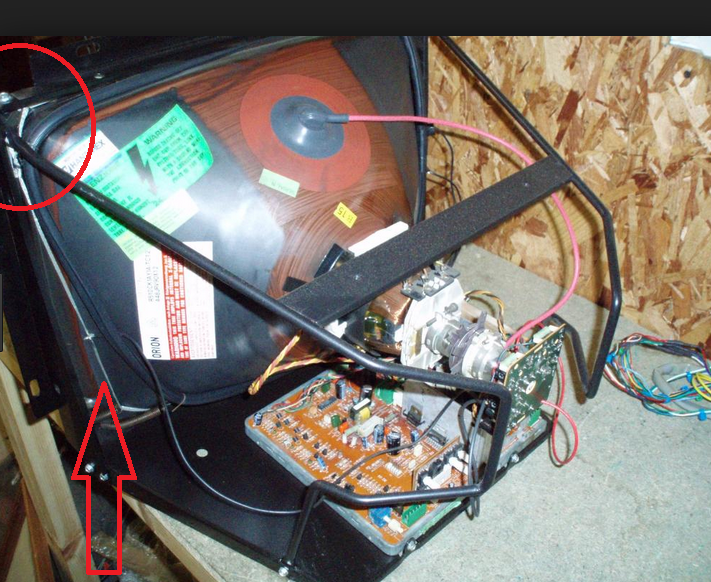
Could I ask if one of you guys that know a lot more about this than the rest of us could you put a piccy of where put the croc clip on this earth braid that wraps around the tube. It would help me and i'm sure other guys that are getting into the restore business.

cheers guys for all your input much appreciated
Tony
 

Purity

The Oracle
vacBacker
Feedback
17 (100%)
Credits
2,999CR
MTC9000Strap.png


There you go. The arrow is pointing to the ground strap that wraps round the tube. You will notice that it also wraps round the frame (circled) so you can clip to the frame as long as there is continuity between the ground strap and the frame, because essentially you are clipping to the same thing
 

edget2000

Active member
Feedback
7 (100%)
Credits
135CR
cheers mate your a star ... I've taken a few monitors out but that strap is something that you don't really notice so thanks for that. I'm now confident that I'm not gonna shock myself
smiley20.gif
much!!
 

Purity

The Oracle
vacBacker
Feedback
17 (100%)
Credits
2,999CR
The only thing I don't like about using a screwdriver is that you have no way of telling if you have fully discharged the tube. As others have said you can get build up again even after you discharge it, so I'd wait a few minutes then do it again, wait a few minutes then do it again

With a HV probe you can plug it into a multimeter so you can see if there is any charge left

Also discharging a vector monitor with a screwdriver is a bad idea. You definately need a HV probe then
 

seanr28

Active member
Feedback
9 (100%)
Credits
319CR
bearing in mind that most (not all) tubes / chassis discharge them selves after a few minutes. I used to use a HV probe to ensure discharge, now I just give them a few minutes before I dismantle them.
 

obcd

Active member
Credits
3,830CR
And make sure you discharge again before you reconnect the anode plug. The voltage won't build up again up to 20000V, but it can still be shocking experience if you decide to clean the dust of the anode connection a couple of days after you discharged it. If you have a 1Meg - 10Meg resistor in serie with your discharge wire, the spark you get upon discharge is much smaller and less frightning. It's also better as a large spark can cause a welding effect. After discharging like that, I usually simply do another run with a direct connection. (without the resistors.) As most voltage should be gone, you shouldn't get a large spark anymore as well. If you add resistors, use 2 or 3 inserie as usually they aren't designed for 20kV.
 
Top