Protecting a PCB in a machine

neoretro

Active member
Feedback
11 (100%)
Credits
1,121CR
Hi all,

Just wondering if there’s a way you can protect a PCB from getting fired in the event of a surge or some sort of catastrophic failure of a power supply.

Thinking a scenario where for some reason 10 volts might get sent down the 5 rail and kiss goodbye to your board.

There anything you can put in somewhere to stop it?

Thanks

Dave
 

sukhbir

Active member
Feedback
46 (100%)
Credits
1,735CR
Simply put rated fuses in line with the 5v,-5v,12v input to your jamma or non jamma harness.for example if your PCB uses 4 amp on the 5 volt rail then put in a 4.5 amp fuse.
 

DonkeyKongler

Newbie
Feedback
1 (100%)
Credits
112CR
unfortunately that doesn't help.
fuses are much too slow and only protect against overcurrent and not overvoltage.
the only safe way is to use appropriate Z diodes.

"10 volts might get sent down the 5 rail"
such a thing is very unlikely.........DonkeyKongler2022-01-14 09:59:52
 

neoretro

Active member
Feedback
11 (100%)
Credits
1,121CR
DonkeyKongler said:
unfortunately that doesn't help.
fuses are much too slow and only protect against overcurrent and not overvoltage.
the only safe way is to use appropriate Z diodes.

Glad someone else said this as I was too scared to challenge.

I’ve got some boards which need a good ampage power supply to keep it going (Nemesis and X Multiply seem to really struggle)

It’s primarily the voltage that would be the concern.

Z diodes I will look into.
 

John Bennett

Senior Member
vacBacker
Feedback
10 (100%)
Credits
5,332CR
Do Zener diodes of significant power capability exist that'll sit there absorbing a continual overvoltage without exploding?

One possible technique might be to use a crowbar circuit and a fuse. Basically a big-ass transistor that switches on when the 5V rail gets above 5.5V and shorts out the power rail to ground. You then have an in-line fuse that pops (to avoid hammering the PSU, although if it's jumping that high, you ought to bin it anyway).

John Bennett2022-01-14 10:06:17
 

DonkeyKongler

Newbie
Feedback
1 (100%)
Credits
112CR
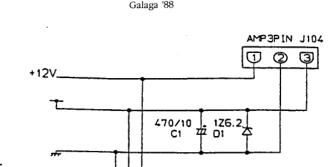
namco does something like this in its system 1 pcbs.
when the voltage reaches more than 6.2 volts, the z diode (D1) becomes conductive and protects the pcb

Z-Diode.jpg
DonkeyKongler2022-01-14 10:09:56
 

John Bennett

Senior Member
vacBacker
Feedback
10 (100%)
Credits
5,332CR
How big is the zener in System1?
The problem I see is that you've got PSU's that'll do over 50Watts and typical zeners are 1 Watt, so they're not going to survive anything more than a little transient. Hence why I think people team them up with a crowbar circuit to kill the line.

I think a broader question is - how good is your SMPS? I do wonder how well a lot of the power supplies sold for arcade stuff compare to buying something industrial (e.g. an open frame PSU from RS/Farnell -well for the 5V anyway). The fact some people suggest cranking up the voltage to get Midway games to exit the POST is frightening - a good PSU should hold 5.0V within a quoted %, without getting upset that the game current varies and you should be able to trust it not to go mad and shove 7V onto your board.
I was going to get something industrial to do some tests vs the nondescript JAMMA PSU thing I used now, but as always, it's about having the time...
 

DonkeyKongler

Newbie
Feedback
1 (100%)
Credits
112CR
sukhbir said:
It’s the current which kills not the volts

not in a "10 volts might get sent down the 5 rail" scenario

John Bennett said:
How big is the zener in System1?
The problem I see is that you've got PSU's that'll do over 50Watts and typical zeners are 1 Watt

it doesn't matter in this case
because it works as a short circuit, it becomes and remains conductive and then has to be replaced.DonkeyKongler2022-01-14 10:58:04
 

John Bennett

Senior Member
vacBacker
Feedback
10 (100%)
Credits
5,332CR
OK, so your PSU goes to 6.5V because it's dodgy.
The current draw is going to remain about the same, until something on the game PCB packs-in and goes short circuit. That'll blow the fuse, but too late.

If your game PCB has that zener on it, then that'll conduct to hold the PSU at 6.3V. The power supply will fight to raise that to 6.5V and could shove out 15A to do it. That zener will get stinking hot as it's only rated for a watt (at a guess). Maybe that's alright, but if it fuses, then you're back to 6.5V as it's gone open-circuit and is in parallel with the supply, not in-line.
 

John Bennett

Senior Member
vacBacker
Feedback
10 (100%)
Credits
5,332CR
Hmm, I'd always thought it could go either way and it wasn't something you'd design for.
It's the tiny little glass device in the bottom corner, isn't it?
galaga_88_01.jpg


Well, debate aside this is a crowbar circuit using a thyrsistor:

Crowbar Circuit Diagram Design & Working (circuitdigest.com)

The zener sets the turn-on voltage and the dirty-big thyristor does the work of killing the power rail/fuse.

Does feel a bit overkill vs. a PSU of known quality and you wouldn't bother for the -5V or the 12V.

John Bennett2022-01-14 11:48:55
 

Phils Arcade

Senior Member
vacBacker
Feedback
10 (100%)
Credits
1,529CR
There are a number of cheap SMPSs that will add noise to the circuit, which isn't good for older type boards, never mind voltage or current overload. I've even seen them affect lighting in a studio that's plugged into the same power rails.
Infurious2022-01-14 12:33:58
 

ColinD

Active member
Feedback
6 (86%)
Credits
1,367CR
You won't have much fun putting a fuse on the 5V line as there will be a volt drop across it, depending on the load current and you would have to turn the 5v up a little to compensate. 12V won't be so much of a problem.

You want Zenners / Crow bars / Power Supervisor and Control and Overcurrent protection.

Zenners and crowbars will basically short out the power supply if there is an over voltage, crowbars more brutally so.

Zenners would 'start to conduct' at their set voltage but not perfectly (might cause the psu to power cycle continuously) but a crowbar would often use a thyristor across the power that's triggered by an overvoltage, you risk damaging the power supply.

Power Supervisors act like a switch.... Would initially check the incoming voltage then switch it to the output if it was ok, if it went out of spec (an over voltage or perhaps there was a high current draw) it would then turn the output off to keep things safe.

You also might consider having some decent power supply filtering (inductors / capacitors) too.

ColinD2022-01-14 13:27:41
 

RaveN

Active member
vacBacker
Feedback
1 (100%)
Credits
1,325CR
Why would 10v get sent down the 5v rail?

That would be one dodgy Chinese SMPS to do that... and then what would happen to the other rails?
You can't protect against everything. I would go the cheaper route and forget crowbar circuits and use rail clamping diodes, because otherwise by the time the Zener's had conducted then most of the IC's would have probably died anyway.

Infurious: "There are a number of cheap SMPSs that will add noise to the circuit": All of them do, they're all fairly cheap and noisy, not great for this application and full of fake capacitors (hence why they're ~£20-30)
 
Top