

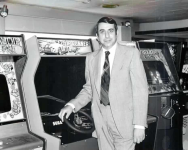
David Rosen wasn’t a hardware designer or a programmer, but he was the man who created the conditions that allowed SEGA’s greatest hardware and arcade eras to exist.
In the early 1960s, Rosen transformed a struggling jukebox and amusement business into what became SEGA, and crucially, he positioned it as a technology-led arcade company, not just an operator or distributor. That distinction shaped everything that followed.
Under Rosen’s leadership:
• SEGA invested heavily and early in in-house R&D
• Arcade machines were treated as engineering products, not disposable cabinets
• The company embraced risk, innovation, and custom hardware, even when it was expensive
• Arcade was the core of the business, not a side arm to consumer sales
That mindset is why SEGA later had the confidence to:
• Build fully bespoke arcade boards rather than rely on generic designs
• Chase bleeding-edge ideas like real-time 3D, motion cabinets, hydraulics, and networked machines
• Back engineers and visionaries like Yu Suzuki with the budgets and freedom they needed
By the time we reached:
• Model 1 → Model 2 → Model 3
• Virtua Fighter, SEGA Rally, Virtua Cop, Daytona, Scud Race
Rosen was no longer hands-on — but the company culture that enabled those machines was his legacy.
He also pushed SEGA beyond arcades:
• Supporting the Mega Drive during its aggressive, creative peak
• Allowing the Saturn to exist as a powerful, arcade-focused console — flawed commercially, but beloved by arcade fans for what it tried to be
David Rosen didn’t design the boards.
He didn’t write the code.
But without him:
• There is no SEGA as we know it
• No fearless arcade R&D
• No Model 2 or Model 3 golden age
Engineers built it.
Yu Suzuki led it.
David Rosen made it possible.
A true founder, and a giant of arcade history.
R.I.P. David Rosen.
(All mistakes courtesy of ChatGPT)