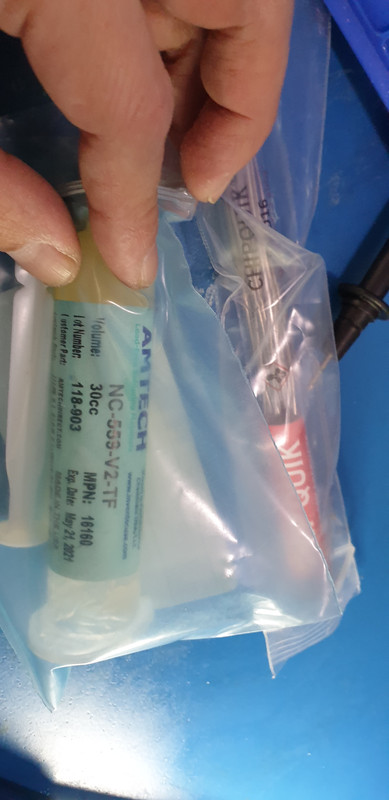
I'm probably going to be repairing a Sega eighteen wheeler cart by block replacing all the smd buffer chips. I've never actually worked with these before so in preparation I acquired some low melt alloy solder,some flux and some alcohol wipes I'm still awaiting some braid to remove the excess solder and clean the pads.
Now the low melt solder is an expensive 75°c one and straight away I realised my cheap rework station starts at 200°c so I suppose I could have bought the 135°c alloy solder at a much cheaper price doh!
Secondly I bought the flux in 2g tubes where you have to cut the nozzle to allow it to come out. It works but the application with these tubes is not as precise as using the syringe ones. I feel I probably used much more than necessary but it's not that expensive.
I didn't have any old computer rams to practice on,but remembered that I had an old football champ I'd got in a job lot of PCBs. It had never really worked and I realised that a large square chip had a lot of bent pins and hard flux in those areas, so I thought this could be my victim. I believe if you pressed down on this chip the game booted and look pretty ok.
I fluxed all the legs and started to add the alloy, initially I tried to use as little as possible but realised that you need all the legs on each side to be coated as one to allow you to run your iron round and round the chip to get all the soldered legs to a high enough temperature for it's removal. I guess on a 2 sided diddy buffer chip that's going in the bin it will be far easier to remove.
Anyway after about 5 mins of applying more alloy and running the iron around each side the chip lifted and without the braid I cleaned the PCB up as best I could. Now the chip itself has some bent pins on it where I tried to lift it to early and all the legs are link together by the alloy solder mix but I'm sure once I've got the braid I can correct this.
So this is the current state of the PCB where this chip goes at present before I clear the old solder with the braid and re-tin the traces.