GORF U15 (DATA) IC

Macro

Active member
vacBacker
Feedback
4 (100%)
Credits
1,982CR
I looked into them a while ago, but because of the power pins moving,
the need for resistor ladders etc. I decided that each would need it's
own custom PCB and that it would be cheaper to put the entire thing into
an FPGA instead.

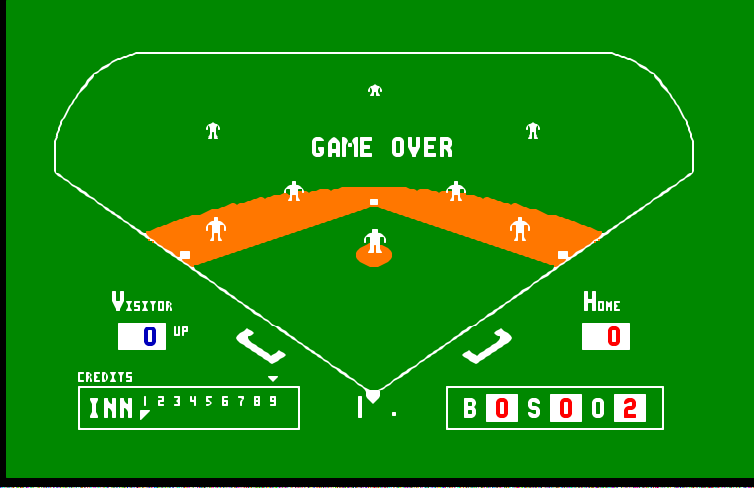
I am currently working on putting Arcade Astrocade into Mister and have two games running (no sound on Seawolf II since it's all discrete - will
add that later) - Now adding
the pattern board code (aka Blitter - for Space Zap onwards)
20200212_221814-screen.png


20200212_221906-screen.png
 

MarcoZ

Newbie
Credits
66CR
Hell on Earth
smiley22.gif


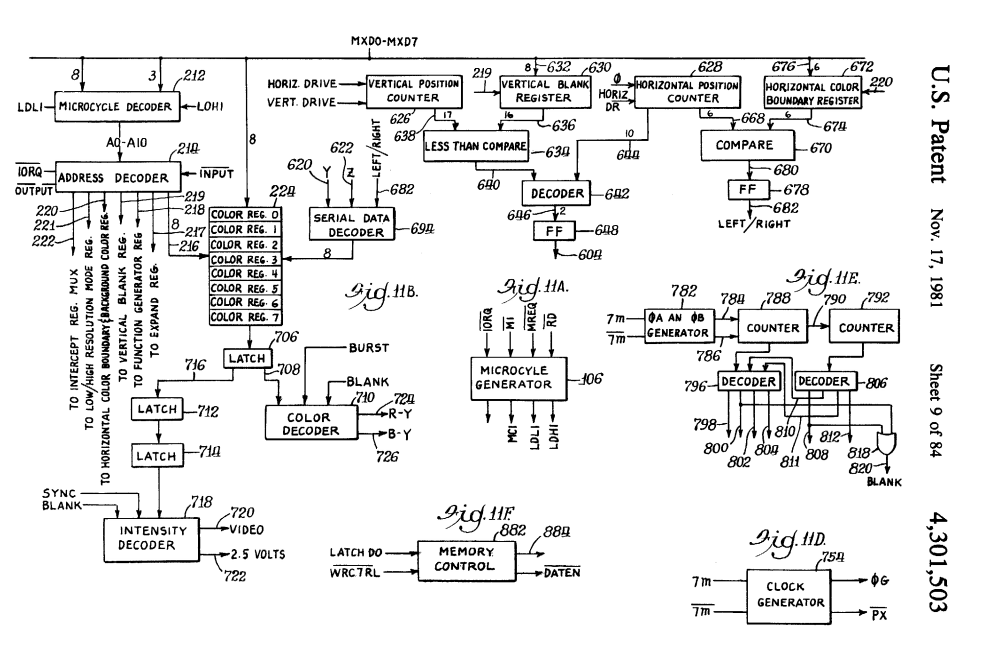
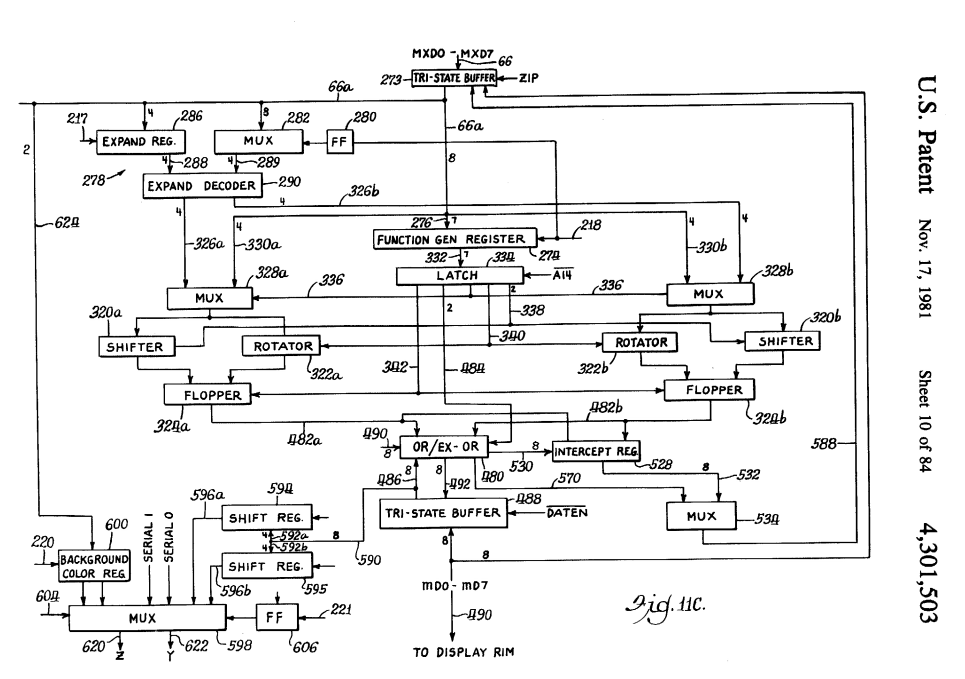
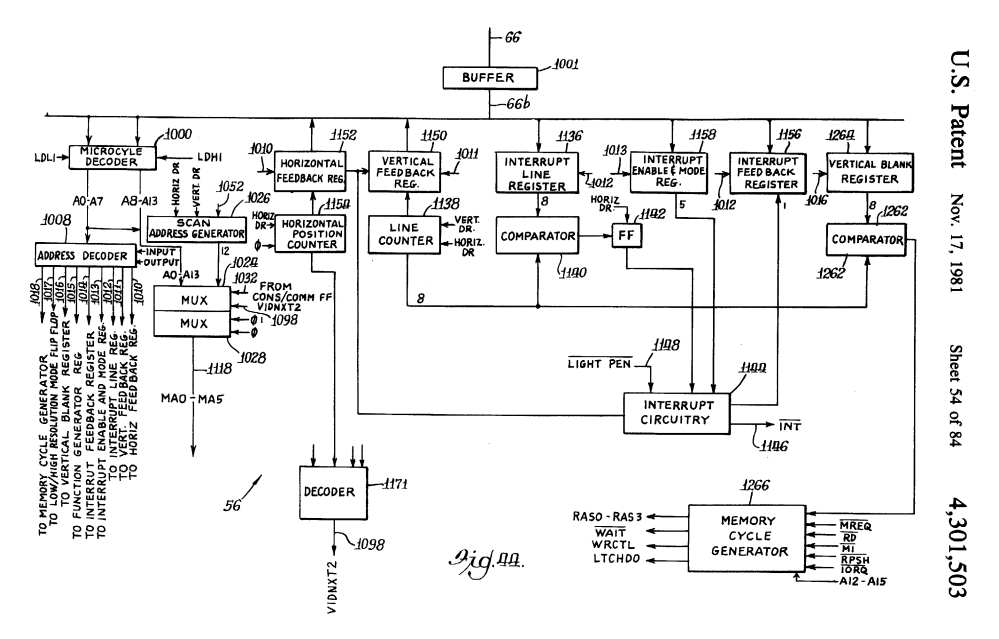
found the patent of the bally game system (237 Pages)

WTF

If you wanna see take a lot time and....

https://www9.zippyshare.com/v/4imBSngi/file.html

Deepest custom Chipinfos ever.

Now I know why no one did this before
smiley4.gif


interesting, so much technology but no real sprites, Planes, DMA , no fancy soundwaveforms (only 1 bit Audio per channel) but complex anyway.

DataIC.png


DataIC2.png


ColorGen.png


Lightpen.png


IO_CHIP3.png


MarcoZ2020-02-13 13:56:46
 

Macro

Active member
vacBacker
Feedback
4 (100%)
Credits
1,982CR
MarcoZ said:
no real sprites, Planes, DMA

Nice find!

on the arcade hardware the sprite / blitter function is all done by the pattern board - basically it can copy data from anywhere to anywhere taking 4 cycles per byte (and increment source and destination addresses seperately, and I guess if you blit to the 'Magic' addresses, you can do all the operations that can as you copy the data.

it is used to scroll the screen instructions in gorf - copying the whole screen up 1 line at a time - no scroll registers on this beast!
 

MarcoZ

Newbie
Credits
66CR
Thanx a lot Macro !

I didnt know this. very interesting. A blitter with 74ls parts. Nice too !

Didnt figure out what the hell this pattern board did yesterday ...

so the gorf ships will all blitted with this pcb ?

How do the hardware do this sparkle effekt on Wizard of Wor when you hit the wizard ?

Is this Magic / or Patternpcb ?

This starfield in WOR is a function of the videochip inside or is this programmed ?

regarding your post:

"... I decided that each would need it's
own custom PCB and that it would be cheaper to put the entire thing into
an FPGA instead.

What exactly does this mean ? you build a pcb with discrete parts for the custom ic or parts of the custom ic ??

"

M

MarcoZ2020-02-13 16:09:59
 

Macro

Active member
vacBacker
Feedback
4 (100%)
Credits
1,982CR
It looks like the sparkle circuit only exists in Gorf and Wor - and it's on the game card.

It modifies the output from the normal video line (labelled Video - the sync / yellow (which is basically video intensity) - looks like it could be driven from Ser1/Ser2 on data chip

for the comment - each custom has power pins in different places, and most would also need some form of analogue circuit - for data chip probably resistor ladders, for IO/sound a resistor and capacitor to allow use of PWM, for IO chips capacitors for reading pots. etc.

unless of course the chip you use to implement them has some form of ADC/DAC built in (would help no end!)

Macro2020-02-13 21:47:18
 

MarcoZ

Newbie
Credits
66CR
Hi Macro, Thank you.

Yes now I realize this U17 U12 U11 Shifters and the Mixer U20 wich add the star data to the video signal from data ic.What an effort to implement a background plane ...

the dac will be a rc on a Port Pin.

ADC i dont need at the moment ( I think) no pots or paddles.

the crude b-y , r-y crap and Y need different ladders :-(

yes it would be 3 different pcbs at the end.

but if you implemented seawolf allready, you finished the vhdl for the custom chips allready ?

Why you not release this and save me a lot of work ?

MarcoZ2020-02-14 09:33:52
 

drcurtis

Newbie
Credits
6CR
I sent a bad U15 chip to a place called Silicon Investigations last summer. The guy got as far as microscopically slicing and scanning the chip but apparently had some health problems. I got a reply a few months later that he was back at it and needed extra chips, and then never heard from him again.

Yesterday I e-mailed him and it bounced back. The website is no longer active, either, unfortunately.
 

MarcoZ

Newbie
Credits
66CR
Thats sad.

Same story with a colleague who send preprogrammed uC to china,

they destroy it and asks for more devices ....

In Russia someone open up ICs too and read the content with microprobing.

In case of U15 this is not an programmed uC or Processor like the Namco / Namco MB8xxx 4bit CPU Controllers. Its a mixed digi/analog bipolar chip like the Commodore VIC or SID chip.

You cannot read out the content, only if you be careful, sllice layer by layer

and photograph the chip masks.

But no one is able to recreate the product because the 5 micrometer fabs who do Bipolar process

are all out of business.

Maybe Tesla Company (ex Soviet IC plant) in Chechoslovakia have some old machines ....

quote from Jeff Frederiksen, the Lead Chip Developer with Dave Nutting Assoc.

"In spite of the simplification from using a processor, there was still
significant display and i/o control electronics. My thought was to simplify
this further by using a custom chip set. This was when I designed the Bally
Arcade chip set using AMI. The main designer at AMI that converted the TTL
design to silicon was Brian Taylor. We used 5um technology - large enough that
we could debug silicon with a microscope and cat whisker probes. Although the
chip set was primarily designed for commercial coin-operated games, I further
designed the Bally Arcade as a possible home market. A cute gimmick added to
this design was the expansion connector to allow an external keyboard, etc. for
home computing. Bally went ahead with the Arcade, but when asked to go ahead
with the computer add-under using the ZGrass graphics language invented by Dr.
Tom DeFanti, the Bally execs said there was no future in home computing -
probably their biggest blunder.

"

cheers

MarcoZ2020-02-14 16:49:19
 

bonehead

I'll get pix tonight
vacBacker
Feedback
49 (100%)
Credits
1,719CR
This is amazing stuff. I would love so much to keep my gorf game alive. One of the best arcade machines ever made in my opinion.
Please keep up the good work.
Thanks
 

ataridude74

Active member
Feedback
1 (100%)
Credits
253CR
How many broken Gorf boardsets are there? Too many.

I had to import a working set from the US, cost a packet, and all due to that single custom chip.

Good luck Marco, we're all counting on you!
 

Gorf

Newbie
Credits
6CR
It makes sense that the sparkle circuit is done on a pixel clock by pixel clock timing basis, but what I do not understand is how they keep it from affecting all color registers at the same time. It seems to me that the 3 bits of intensity for whatever color register they wish to sparkle is updated on a PX by PX clock resolution. The stars are as someone pointed out 'injected' so to speak into the video signal by some repeating and stable random placement that repeats itself every frame and also changes the particular intensity of each star pixel. You will also notice that each star is twice the size of
a normal pixel. Does anyone have the area in the schematics where either of these take place?

Thanks

Steve

BTW... excellent find on the patents info.
 

Gorf

Newbie
Credits
6CR
it seems that whole left side of that game board circuit is controlling the stars and sparkles.
Quite an interesting set up. It's all timed by the 7M, Vdrv and Hdvr signals.
 

Macro

Active member
vacBacker
Feedback
4 (100%)
Credits
1,982CR
top left of page 69 on the schematics linked earlier.

it injects into the 'Yellow' line, which is basically the intensity (for b&w you only need to hook up this line)
 

Macro

Active member
vacBacker
Feedback
4 (100%)
Credits
1,982CR
MarcoZ said:
but if you implemented seawolf allready, you finished the vhdl for the custom chips allready ?
Why you not release this and save me a lot of work ?

it's already out there, done by Arnim Laeuger back in 2007 - but it is not complete for signals that the FPGA side of things don't need. (RAS / CAS / etc) - (just look for Bally Astrocade FPGA project - Mister one is at https://github.com/MiSTer-devel/Astrocade_MiSTer)

The home version does not have the pattern board, sparkle circuit, SC01 and probably some other bits I haven't found yet!

The one I am doing starts of with that code, but adds in the relevant extra bits

but it basically works (not convinced the timing is totally correct, but that may just be my understanding of his code!)

Macro2020-03-10 18:26:16
 
Top