Pentranic chassis screen jumps

Retroman839

Senior Member
vacBacker
Feedback
12 (100%)
Credits
7,134CR
Ok I got this pentranic ch-288 cga only type chasiss ..

I was reading online about this chasiss and some of the vertion of this chassis have a fault where because it takes 18v power from the flyback
To power the ic 2 that handles

Vertical oscilatór and other stuff..

On all white screens like flashes on gun games ..

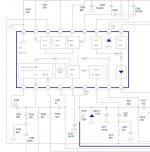
The flyback working to create the bright white image causes to much current / voltage over load to the ic2 vertical vcc

See here
IMG_7203.jpeg
Pin 6 vertical vcc

A guy called
“Rick ..”. Who seems
To have worked for the company
put info online for a fix mod
That requires taking power from a new location ..

Here is the guy saying what is required to do

Yes, that is correct. The R318 modification on certain CRT monitors (specifically mentioned for the Pentranic/Makvision CH288-2425 chassis) was developed to change the source for the vertical circuit's VCC (power supply).

  • Original Setup: The vertical VCC was supplied by the flyback transformer.
  • The Problem: During high-intensity scenes (like white flashes in gun games), the high voltage would fluctuate, causing the vertical VCC to jump and resulting in a "jumpy" or unstable picture.
  • The Mod: By changing the supply source to a stable DC rail via a new resistor (680 ohms recommended) at R318, the vertical circuit receives clean power, preventing the jumping picture.
The mod involves running a resistor from D306 to the empty hole at R318.


I don’t understand empty hole ?

If I change the resistor at r318

Which I have found
Here IMG_7187.jpeg
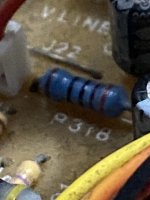
To a 680 ohm as discribed …

Where is my empty hole
To link the new power source from D306 going to be ?

link to a schimatic


Schimatic for 15khz /25khz type ..

Mine only 15khz type but chasiss does compare to the schimatic ..

My symptom is exactly as discribed any time screen Goes white my screen jumps..

Apart from this chasis perfect . Só it’s bugging me
As I would have a Nice 15khz monitor ..

Anyone help with me getting a stable power source to the vertical vcc at pin 6 ?

I have new tantlium cap to put in at c318 to see if this helps.

Maybe change r318 to a 680 ohm as he says …

But then the empty hole bit just confused me

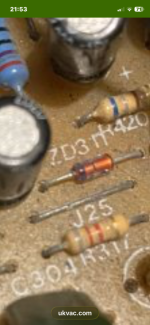
I’m not seeing any holes in the zone around r318
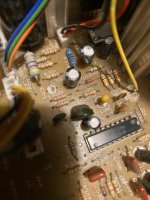
IMG_7204.jpeg
Any ideas appreciated thnx
 
Last edited:

Georgian2

Active member
Feedback
12 (100%)
Credits
1,738CR
My understandig is that you need to remove that resistor and put an 680Ohm in but only one leg in the hole that leads to the IC. The other end must be linked to D306.
Maybe with full schematics an more experienced user can help better :)
 

Retroman839

Senior Member
vacBacker
Feedback
12 (100%)
Credits
7,134CR
18v

Looks like that zener zd3 then print is non de script

Will check it’s in circuit volts
Asap

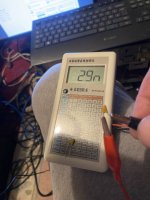
Swapped tantilum
image.jpg


I know my esr meter isn’t a peak

But this is what i get
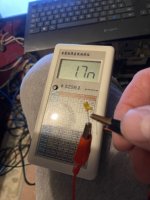
IMG_7210.jpeg
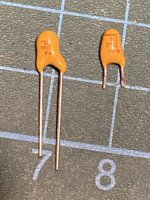
The one i pulled

And new one going in

IMG_7211.jpeg


Not sure if that’s just the long legs not being snipped off ?

Almost 50 percent change
 
Last edited:

M K L

Active member
Credits
1,008CR
It's possible that the allegedly stable voltage source is the 24V from the power supply rectified by D506 (D306 being a typo?). The voltage at pin 6 of IC2 will be in any case 12V because of ZD311 (a simple zener voltage regulator).
 

Retroman839

Senior Member
vacBacker
Feedback
12 (100%)
Credits
7,134CR
It's possible that the allegedly stable voltage source is the 24V from the power supply rectified by D506 (D306 being a typo?). The voltage at pin 6 of IC2 will be in any case 12V because of ZD311 (a simple zener voltage regulator).

Could be ..
Só I guess question is

Wouls a 680 ohm resistor of what wattage ( 1/2 or 1/4 )

Get near to the required voltage ..?

Options d506 or
Zd306


Thx all this has given me some nice options 👍😊
 
Last edited:

M K L

Active member
Credits
1,008CR
Could be ..
Só I guess question is

Wouls a 680 ohm resistor of what wattage ( 1/2 or 1/4 )

Get near to the required voltage ..?
The purpose of the resistor is limiting the current. It's the zener diode that sets the voltage. In this case, ZD311 is 12.2V. We're talking about a simple and common circuit called "zener voltage regulator" that consists of three components. A current limiting resistor in series with the input voltage, a zener diode with cathode to output voltage and anode to ground and a smoothing cap in parallel with the diode. These parts here are R318, ZD311, C316. The value of the resistor depends on the current draw of the load supplied by the circuit (the vertical section of IC2 HA11235). With an input voltage of 18V and a 100 ohm resistor (indicated in the schematics for 26" tubes), the current draw is 50mA. With an input voltage of 24V, the resistor will be 200 ohm. A 680 ohm resistor (as suggested by this Rick guy) would mean that the current draw is in fact only 7.5mA.
http://www.calculatoredge.com/electronics/zener.htm
If you're not going to measure yourself the current draw and trust the above suggestion, then put a 680 ohm resistor in R318 but keep the leg that doesn't go to pin 6 of IC2 lifted from the chassis. Then solder a wire from the cathode of D506 to the lifted leg of the resistor.

edit: on your chassis R318 is 270 ohm, which points to a current draw of 12mA with a 18V input voltage so 680 ohm with 24V makes more sense now.

edit 2: and just for reference, this kind of circuit is also found on the Hantarex MTC9000 where the 24V line is the input voltage, R29 (470 ohm) the current limiting resistor, ZD1 (ZPY12) the 12V zener that supplies IC2 (TDA2595) and C16 the smoothing cap.
 
Last edited:

Retroman839

Senior Member
vacBacker
Feedback
12 (100%)
Credits
7,134CR
The purpose of the resistor is limiting the current. It's the zener diode that sets the voltage. In this case, ZD311 is 12.2V. We're talking about a simple and common circuit called "zener voltage regulator" that consists of three components. A current limiting resistor in series with the input voltage, a zener diode with cathode to output voltage and anode to ground and a smoothing cap in parallel with the diode. These parts here are R318, ZD311, C316. The value of the resistor depends on the current draw of the load supplied by the circuit (the vertical section of IC2 HA11235). With an input voltage of 18V and a 100 ohm resistor (indicated in the schematics for 26" tubes), the current draw is 50mA. With an input voltage of 24V, the resistor will be 200 ohm. A 680 ohm resistor (as suggested by this Rick guy) would mean that the current draw is in fact only 7.5mA.
http://www.calculatoredge.com/electronics/zener.htm
If you're not going to measure yourself the current draw and trust the above suggestion, then put a 680 ohm resistor in R318 but keep the leg that doesn't go to pin 6 of IC2 lifted from the chassis. Then solder a wire from the cathode of D506 to the lifted leg of the resistor.

edit: on your chassis R318 is 270 ohm, which points to a current draw of 12mA with a 18V input voltage so 680 ohm with 24V makes more sense now.

edit 2: and just for reference, this kind of circuit is also found on the Hantarex MTC9000 where the 24V line is the input voltage, R29 (470 ohm) the current limiting resistor, ZD1 (ZPY12) the 12V zener that supplies IC2 (TDA2595) and C16 the smoothing cap.
Hey thanks for taking time to explain, realy appreciate that.
And also the link to this circuit appearing in the hantarex ..

What about the polo 1&2 ?
Do these take from a transformer rather then from flyback ?
Thanks Dan ..

I’m still waiting for Rick to answer
 

M K L

Active member
Credits
1,008CR
What about the polo 1&2 ?
Do these take from a transformer rather then from flyback ?
On those, the TDA2593 (which differs from HA11235 in having a single supply voltage) is supplied with 12V from a 7812 regulator which in turn is supplied with 15V from the switching power supply.

A zener voltage regulator on the Polo is used to get 5V for the test pattern circuit IC102 (7406) from the 12V line through current limiting resistors R140/R141 and zener diode ZD102 (5.1V).
 

Retroman839

Senior Member
vacBacker
Feedback
12 (100%)
Credits
7,134CR
On those, the TDA2593 (which differs from HA11235 in having a single supply voltage) is supplied with 12V from a 7812 regulator which in turn is supplied with 15V from the switching power supply.

A zener voltage regulator on the Polo is used to get 5V for the test pattern circuit IC102 (7406) from the 12V line through current limiting resistors R140/R141 and zener diode ZD102 (5.1V).
Thanks for that .

It’s handy to know what’s going on down the circuit..

I have a few chassis to go through ..

And this will help to understand the power supply circuit to hot and vertical transistor and to test for voltages along these circuits.
 
Top