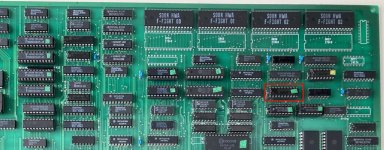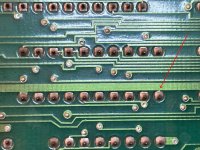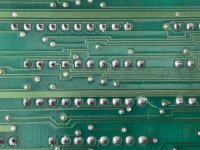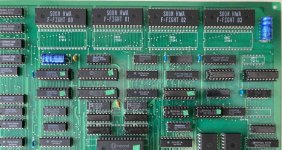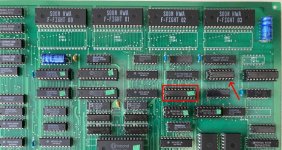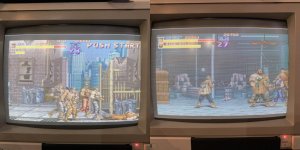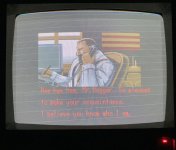

Picked this one up here from a Vaccer about a year ago. Wouldn't boot and I remember it was possibly the first non working pcb I ever bought. I had no experience or useful tools - didn't even own a scope at the time so couldn't even check the clock frequency or do other pretty basic diagnostics. Went pretty quickly into a box of 'I'll get back to that later' and there it sat until a few days ago ... As you can see it was pretty dirty and an empty socket (top right area on pic below) suggested a missing a IC ...
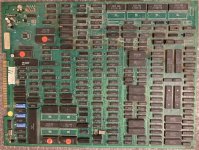
For anyone with the same board , this is the Bootleg (Soon Hwa) with single OKI. ROM set ffightblb. There are quite a few PALs, GALs and HY18CV8 chips on here which don't seem to be dumped and that could be a problem but will just have to see how it goes .. powering up just gave a screen of garbage ...
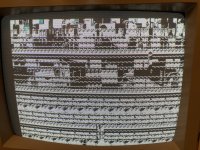
Set about testing all the (testable) socketed IC's. All the RAM on this board is socketed which is really handy but only 2 of the CPU ROMs and both the Sound ROMs are in sockets.
RAM all tested good. the 2 socketed ROM's next to the CPU did not however and so I burned new ones (pgm01.3 & pgm0h.4). Also there are 3 socketed LS245's next to the jamma edge connector and 2 of those also tested bad and got replaced. All other socketed TTL tested good. The missing IC in the top right corner - fortunately I could just about make out LS163 written on the silkscreen under the socket so in went one of those ...
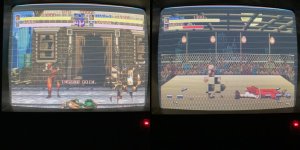
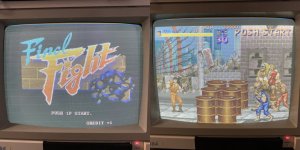
And then game booted ..sort of ... very wobbly/wavy picture at first and a 'no good' fail at 'SCROLL 1' but that cleared up with a voltage boost and then a 'no good' fail at 'OBJ RAM'
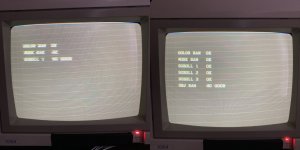
Which also cleared up with another voltage boost and the game started ...
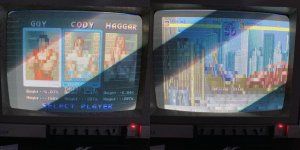
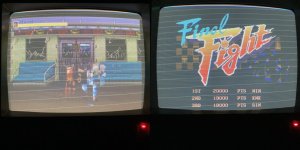
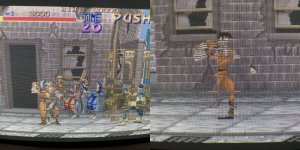
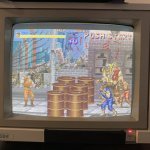
You can see that the text layer looks fine, also appears there are 2 'background' layers with one working fine (background tile layer - skyscrapers) and the other corrupted (foreground tile layer - street, buildings etc). Also, the sprite layer is missing completely ..
So at this point I set about working out which parts of the pcb circuitry handle the different layers. form the Ram test at boot you can see the program labels the layers scroll 1, scroll 2, scroll 3 and OBJ. OBJ must be the sprite layer but not sure on the others (scroll layers) these are most likely the text layer and the 2 background layers.
By shorting address pins on RAM and ROM and looking at the effect on screen it's pretty easy to work out what does what. From there you can trace to relevant TTL. the picture below shows the rough layout.
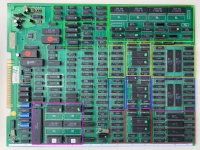
Pink section - WORK Ram - CPU / Program
White - COLOUR Ram
Red - 'SCROLL 1' - Text Layer
Blue - 'SCROLL 2' - FG Tiles
Yellow - 'SCROLL 3' - BG Tiles
Green - OBJ - Sprites
Hunting the FG tile corruption issue was fairly straight forward, probing address pins on the relevant Mask Rom's 10 & 11 (27C400 equivalent) showed some real ropey looking signals on early address lines .... Traced these address signals from the ROM's back to the outputs of a LS86 (shown below). The input signals to the LS86 looked good. Big red flag.
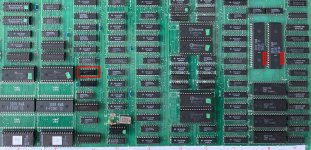
Made by everyone's favourite TTL manufacturer - Fujitsu. If you read online fix logs and watch videos you'll see Fujitsu TTL mentioned time and again as likely fail points and some people just swap them out soon as they see them. I've been lucky I think as I've not come across a bad one before ... maybe this is my first ... pretty confident it is bad but Sliced it to make sure ....
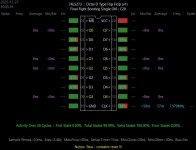
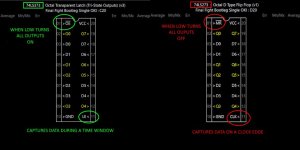
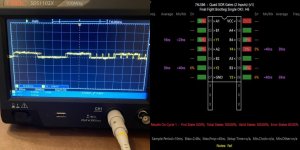
You can see the poor signal (on the left) and the confirmation it's bad from the slice result (on the right) below ...
Cut that out and socketed in a new LS86. This fixed the FG tile layer ...
Now need to find where the sprites are hiding. tbc ........
For anyone with the same board , this is the Bootleg (Soon Hwa) with single OKI. ROM set ffightblb. There are quite a few PALs, GALs and HY18CV8 chips on here which don't seem to be dumped and that could be a problem but will just have to see how it goes .. powering up just gave a screen of garbage ...
Set about testing all the (testable) socketed IC's. All the RAM on this board is socketed which is really handy but only 2 of the CPU ROMs and both the Sound ROMs are in sockets.
RAM all tested good. the 2 socketed ROM's next to the CPU did not however and so I burned new ones (pgm01.3 & pgm0h.4). Also there are 3 socketed LS245's next to the jamma edge connector and 2 of those also tested bad and got replaced. All other socketed TTL tested good. The missing IC in the top right corner - fortunately I could just about make out LS163 written on the silkscreen under the socket so in went one of those ...
And then game booted ..sort of ... very wobbly/wavy picture at first and a 'no good' fail at 'SCROLL 1' but that cleared up with a voltage boost and then a 'no good' fail at 'OBJ RAM'
Which also cleared up with another voltage boost and the game started ...
You can see that the text layer looks fine, also appears there are 2 'background' layers with one working fine (background tile layer - skyscrapers) and the other corrupted (foreground tile layer - street, buildings etc). Also, the sprite layer is missing completely ..
So at this point I set about working out which parts of the pcb circuitry handle the different layers. form the Ram test at boot you can see the program labels the layers scroll 1, scroll 2, scroll 3 and OBJ. OBJ must be the sprite layer but not sure on the others (scroll layers) these are most likely the text layer and the 2 background layers.
By shorting address pins on RAM and ROM and looking at the effect on screen it's pretty easy to work out what does what. From there you can trace to relevant TTL. the picture below shows the rough layout.
Pink section - WORK Ram - CPU / Program
White - COLOUR Ram
Red - 'SCROLL 1' - Text Layer
Blue - 'SCROLL 2' - FG Tiles
Yellow - 'SCROLL 3' - BG Tiles
Green - OBJ - Sprites
Hunting the FG tile corruption issue was fairly straight forward, probing address pins on the relevant Mask Rom's 10 & 11 (27C400 equivalent) showed some real ropey looking signals on early address lines .... Traced these address signals from the ROM's back to the outputs of a LS86 (shown below). The input signals to the LS86 looked good. Big red flag.
Made by everyone's favourite TTL manufacturer - Fujitsu. If you read online fix logs and watch videos you'll see Fujitsu TTL mentioned time and again as likely fail points and some people just swap them out soon as they see them. I've been lucky I think as I've not come across a bad one before ... maybe this is my first ... pretty confident it is bad but Sliced it to make sure ....
You can see the poor signal (on the left) and the confirmation it's bad from the slice result (on the right) below ...
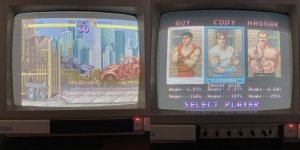
Cut that out and socketed in a new LS86. This fixed the FG tile layer ...
Now need to find where the sprites are hiding. tbc ........