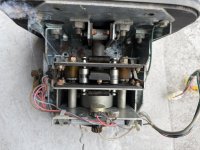
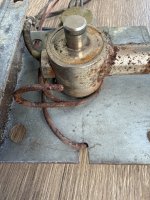
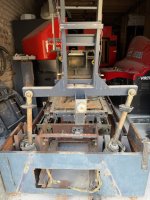
A little more progress on the power supply section. The main components are now off the wooden mounting board, although the board itself is still putting up a fight!
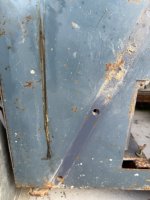
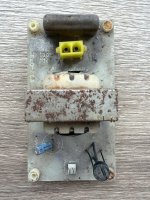
First, a follow-up on the small Sega 839-0339 supply board shown in my previous update: the transformer’s retaining bracket has now been treated for rust. The surface looks much better, although the pitting remains visible.

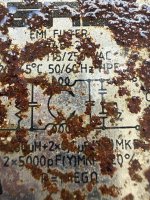
Next was the combined audio amplifier and regulated power supply. The G-LOC manual lists this as 601-6227-02, “PWR AMP W/SW REGU12V5A”, but the damaged label on my unit ends in “6227-01”.
Interestingly, the Daytona USA Twin manual also lists 601-6227-01. That gives us another documented application for this version, although it doesn’t establish where my unit came from or whether the two versions are interchangeable.

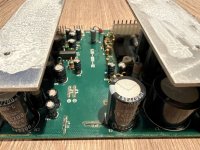
The PCB has received an initial clean, but more work remains. The metal cover is still heavily marked, and I’m looking for a way to clean it without adding scratches or damaging what remains of the label.
I also removed and cleaned the main solid-state relay, an Omron G3PA-220B, corresponding to Sega part 450-5048. This is the relay controlled by the small 839-0339 board.
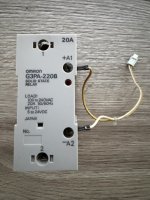
Its markings specify a 100–240 VAC load, rated up to 20 A, and a 5–24 VDC control input. With the cover removed, the power device cartridge is marked G32A-A20. Some corrosion remains on the terminal screws.
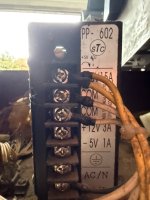
The main +5 V supply has also been removed. The unit fitted to my cabinet is a replacement STC PP-602, rather than the Sega 400-5089 listed in the manual.
The STC has +5 V / 15 A, +12 V / 3 A and −5 V / 1 A outputs, but only the +5 V and COM terminals were connected on the output side.
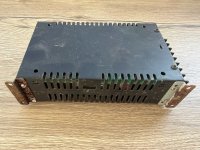
Both mounting brackets are badly rusted and still need cleaning and treatment.
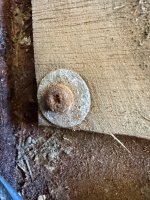
Then came the large Sega 560-5167 transformer. Its rusty mounting screws made removal a little challenging, but it is finally out.
It provides 18.5 VAC / 6 A for the amplifier/regulator assembly and 100 VAC / 2 A for circuits including the monitor, fluorescent lighting, fans and upper warning lamp. Its metalwork still needs attention.

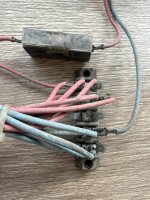
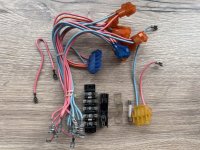
That leaves the wooden board, Sega GLC-4001, with the terminal blocks and some wiring still attached. Unfortunately, its remaining fixing screws are extremely rusty and I haven’t managed to loosen them yet.
This is still the dismantling and cleaning stage. Apart from the fuse on the 839-0339 board, no electrical testing has been carried out, so none of these assemblies has been confirmed working.
More to follow — once those last screws agree to cooperate!






 www.poscope.com