
You are using an out of date browser. It may not display this or other websites correctly.
You should upgrade or use an alternative browser.
You should upgrade or use an alternative browser.
Neo Geo AES+ (new console)
- Thread starter 2DForever
- Start date

I'd be tempted to get a Plasma for the lounge, be good if I wanted to put a Laserdisc on, got quite a few music ones. don't have room for CRT these days but Plasma would be good for older games tooI'll be happy with my Pioneer plasma as the lounge TV until one of us dies.

I recently upgraded my 55” LG OLED (£1100) to a 42” Pioneer Kuro (£28) 😃


So...and apologies I've led it a bit OT but all interesting stuff - what is the current best option to come nearer to a CRT on a flat screen for the incredible NG pixel art? So much of what I see on YT (even with decent upscalers) just looks plain wrong. Without the phosphor glow and merging of pixels it all just seems painting by numbers or 'digital' rather than analogue and 'alive'! You know ..just odd/fake/synthetic/crap.
My RetroTink 5x was pretty good but for £400 I’d rather have a CRT so I sold itSo...and apologies I've led it a bit OT but all interesting stuff - what is the current best option to come nearer to a CRT on a flat screen for the incredible NG pixel art? So much of what I see on YT (even with decent upscalers) just looks plain wrong. Without the phosphor glow and merging of pixels it all just seems painting by numbers or 'digital' rather than analogue and 'alive'! You know ..just odd/fake/synthetic/crap.

I have the same 5090. It's basically the fat version of their last plasma, but with every input connection you can imagine and less processing options (which I turn off anyway). Got it for £300 nearly ten years ago. Superb 1080p image, very good low res, next-frame latency when set to PC Mode.Love my Pioneer 5090, got a Panasonic 50GT65b in the other room. Love plasma.
Last edited:

This is where I get confused - aren’t Plasmas closer to old LCDs than CRTs - digital image, fixed pixels, frame delays.
Anyway, I’d say my 5 year old LG OLED is near perfect - if I could make it last another decade, I would. I don’t get how a Plasma could be better.
With my CRTs, it’s more about the imperfections 🤪 (and a massive 4:3 Rear Projection display)
Anyway, I’d say my 5 year old LG OLED is near perfect - if I could make it last another decade, I would. I don’t get how a Plasma could be better.
With my CRTs, it’s more about the imperfections 🤪 (and a massive 4:3 Rear Projection display)

Emulation + shaders IMO, with a good high resolution panel.So...and apologies I've led it a bit OT but all interesting stuff - what is the current best option to come nearer to a CRT on a flat screen for the incredible NG pixel art? So much of what I see on YT (even with decent upscalers) just looks plain wrong. Without the phosphor glow and merging of pixels it all just seems painting by numbers or 'digital' rather than analogue and 'alive'! You know ..just odd/fake/synthetic/crap.

Maybe Sega are going the same way soon:


 www.linkedin.com
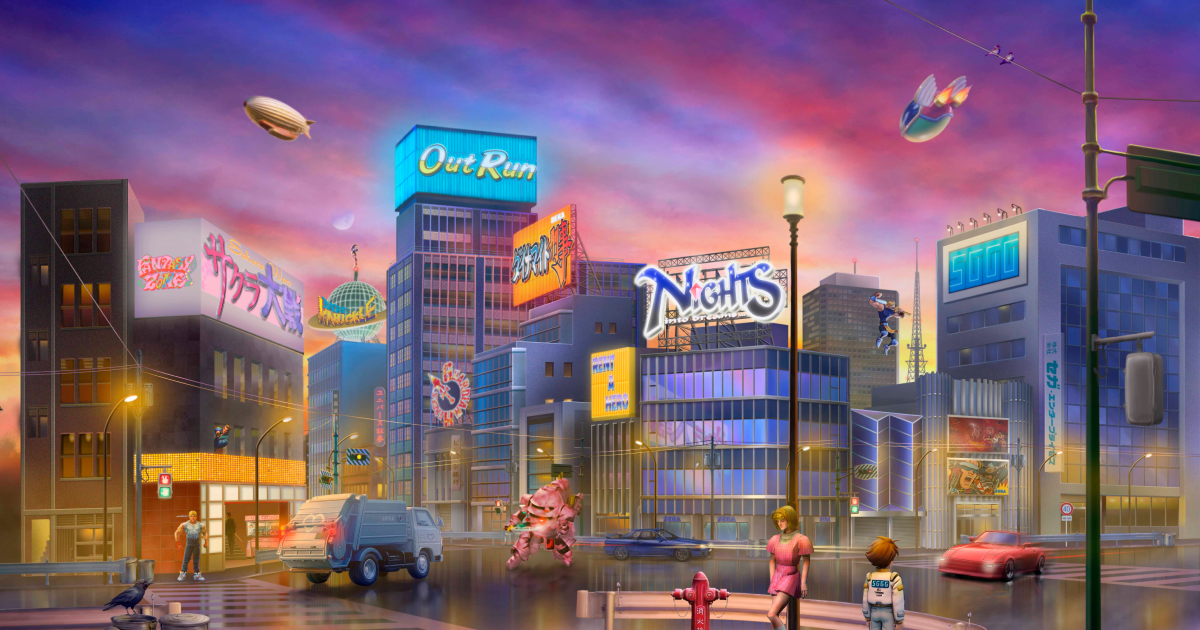
 segauniverse.sega.jp
#sega #セガ | SEGA
A new brand shaping the future of SEGA’s classic IPs, “SEGA UNIVERSE,” is launching! Focusing on titles celebrating milestone anniversaries in 2026, we will roll out special anniversary projects and deliver entertainment that goes beyond nostalgia. セガ往年IPの新展開を担う新ブランド “SEGA UNIVERSE” 始動!...
www.linkedin.com
SEGA UNIVERSE|NO OLD, STAY GOLD
SEGA UNIVERSE公式サイトです。「NO OLD, STAY GOLD」のコンセプトのもと、ファンから今なお愛される旧作タイトルに光を当て、周年を彩る各種企画をご紹介。
segauniverse.sega.jp
Yeah, I'd say Plasmas are just somewhere in between CRT and LCD. Good all rounder, vibrant, nice contrast and 240-480p is passable. OLEDs are better but depend on a good scaler, you can plug anything in a plasma and it'll look okay. The panel texture helps.This is where I get confused - aren’t Plasmas closer to old LCDs than CRTs - digital image, fixed pixels, frame delays.
Anyway, I’d say my 5 year old LG OLED is near perfect - if I could make it last another decade, I would. I don’t get how a Plasma could be better.
With my CRTs, it’s more about the imperfections 🤪 (and a massive 4:3 Rear Projection display)
Always hard to get a number on delay. Response rate is a grey to grey test and has nothing to do with processing delay which is never on a spec sheet. It'd need testing manually. I know my Pioneer is at around 1 frame by videoing while tweaking it to the best settings. It's at around 3 frames with defaults. Guessing many OLED match 1 frame but don't beat it.
This is good reading for me as I've learned a wee bit about plasma TV's that I didn't know, when I bought my 1st pioneer kuro it was only because a local fella worked for a local rental company and said this is the best you are going to get end of you need to buy one and he was right, I've got about 200 hddvd I know Blu-ray won the war but in my eyes hddvd was better and when putting on the warriors or top gun on the pioneer kuro it is a joy to behold.
I put it all through a transcript generator and a translator, but I don't want to get done for copywrite sticking it here. It's pretty much what the summary in that reddit link is though.
So, I think it's as expected - the open-source custom chips, Z80, 68000 used in MiSTer, put into two ASICs. The ASICs will deal with the 5V issue of cartridges.
So, I think it's as expected - the open-source custom chips, Z80, 68000 used in MiSTer, put into two ASICs. The ASICs will deal with the 5V issue of cartridges.
Very interesting, thanks.
Weird complaints about flash memory. Dunno how anyone would have expected anything else.
If you want to save yourself from wading through comments, these are the two decent posts of summaries.
Weird complaints about flash memory. Dunno how anyone would have expected anything else.
If you want to save yourself from wading through comments, these are the two decent posts of summaries.
Johnny_Manz wrote:
To sum up the video for non spanish speakers. Jotego (MiSTer FPGA) has been working on the Neo Geo AES+:
- Neo Geo AES+ will use 2 ASIC chips. All chips from the OG AES will be implemented in those 2 ASIC chips
- Working 1:1 as the OG AES is not a problem, they know perfectly well how the OG works in every aspect
- AV/RGB is the main video output. HDMI is secondary
- Cartridges are expensive and PLAION is not getting much profit (if any) at 80€/90$ (this implies that future games will be more expensive)
- Cartridges use flash memory
- Cartridges will be made in Germany
- ASICS can manage 5v for cartridge, this is why they avoid FPGA (only 2v)
- DAC will be exactly the same as the OG (new construction but same instructions). So, they can get exactly the same colors as the OG
- Timming and clocks for HDMI output are mostly ok except for two games (one is Neo Turf Masters) as they have to use some tricks to avoid glitches.
- They have a budget for two production run in this first batch/launch (in case the first run has issue with ASICS bugs, etc,)
Raumgleiter wrote:
All games are OK on HDMI. he just said that Neo Turf Masters needed an additional "adjustment". And the 2 production runs I understand is due to using ASIC, as you cant reprogram them like FPGA if something is wrong. So they say they have a budget to do a 2nd production run if the first one craps out.
Considering he is so pedantic on the DAC chip they use, I cannot imagine they take any shortcuts.
There are a few other interesting things mentioned:
Background & Company
Made by Splion, an Austrian company, though Jotego worked with their UK-based team
Splion had previously made console replicas using emulation, but emulation always had compatibility issues and imperfections
They decided to do it properly this time with dedicated hardware
Why ASIC Instead of FPGA
FPGA was considered but ASIC worked out cheaper at the production volume they planned
ASIC can run at 5V, which is required to be compatible with original Neo Geo cartridges — FPGA boards typically run at 2.5V or 1.8V, which was problematic
Risk acknowledged: if there's a hardware flaw in an FPGA you just edit the code, but with ASIC you have to scrap everything and redo validation — they budgeted for one potential respun
The Chip Design
The original Neo Geo had 6–8 chips; this console condenses everything into just 2 custom ASICs
Jotego compared this to the Mega Drive 1 → Mega Drive 2 redesign: fewer chips, same functionality
Manufactured in Germany, not China or Taiwan
José noted surprise that it came out cheaper despite being two chips and European manufacturing — attributed to economies of scale, not EU subsidies
Jotego's Specific Contributions
Provided their Neo Geo FPGA IP (published open-source but with restrictive commercial conditions, so Splion contracted Jotego directly)
José personally reviewed the project design twice over several days
His key insistence: the color DAC must replicate the original — using the exact same resistor network and period-compatible chips, not a modern DAC — because a modern DAC would produce different colors and brightness levels
The DAC circuitry sits outside the ASICs as discrete components, because it needs to be analog
Licensing & Legal
SNK license was obtained and SNK reviewed and approved the project
Jotego made sure no open-source licenses were violated and that everyone whose work was used was contacted
José described the team as careful about respecting both what SNK wanted and all third-party IP
Cartridges
Compatible with original Neo Geo cartridges (old carts work in the new system and vice versa)
Launching with 10 cartridges, with more planned
Cartridges are expensive to produce — large connectors with many pins, must match original form factor
Cartridges are actually the part of the product with the least margin/profit for Splion despite being the most visually attractive to consumers
Video Output
RGB output is the "true" mode — connect to a CRT monitor for the authentic original experience
HDMI output is available but required a small frequency adjustment for compatibility
This adjustment was only strictly necessary for one golf game; most games were fine without it
Memory cards are fully compatible — original Neo Geo memory cards work in the new system
I know you couldn't expect anything different, but it's kinda upside-down that SNK are selling a system based on reverse engineering of their own chips by the public.
Not saying the outcome would be any better of course had they done it themselves with original designs they probably lost decades ago.
Have they made these ASICs yet, or is this a risk they still have to take?
Would be nice if it somehow paved the way for cheaper 5V ASICs (would have to knock a fair few zeros off the setup cost to benefit hobbyists, mind you).
Not saying the outcome would be any better of course had they done it themselves with original designs they probably lost decades ago.
Have they made these ASICs yet, or is this a risk they still have to take?
Would be nice if it somehow paved the way for cheaper 5V ASICs (would have to knock a fair few zeros off the setup cost to benefit hobbyists, mind you).
